SAN FRANCISCO, Nov 5, 2025 - Gene therapy fights disease at its source by targeting the exact cells responsible for dysfunction.
But if a gene therapy activates outside of its target, it can expose the patient to high toxicity. Cis-regulatory elements (CREs) are DNA “switches” that control where and how strongly a gene is expressed. CREs have immense versatility: just a 200 base pair CRE has over 10^120 possible configurations.
CREs have the potential to give researchers unprecedented control over gene therapy expression; but the combinatorial search space has historically made them impractical to design.
In 2024, researchers from Yale and Harvard used AI to design thousands of CREs with highly precise activation in target cell lines (Gosai et al., 2024).
However, they hit a key limitation: at high activation predictions, when a CRE should be strongest, their model’s accuracy falls precipitously. This creates a bottleneck for AI-driven regulatory design, because the most promising sequences lie exactly in these poorly predicted regions.
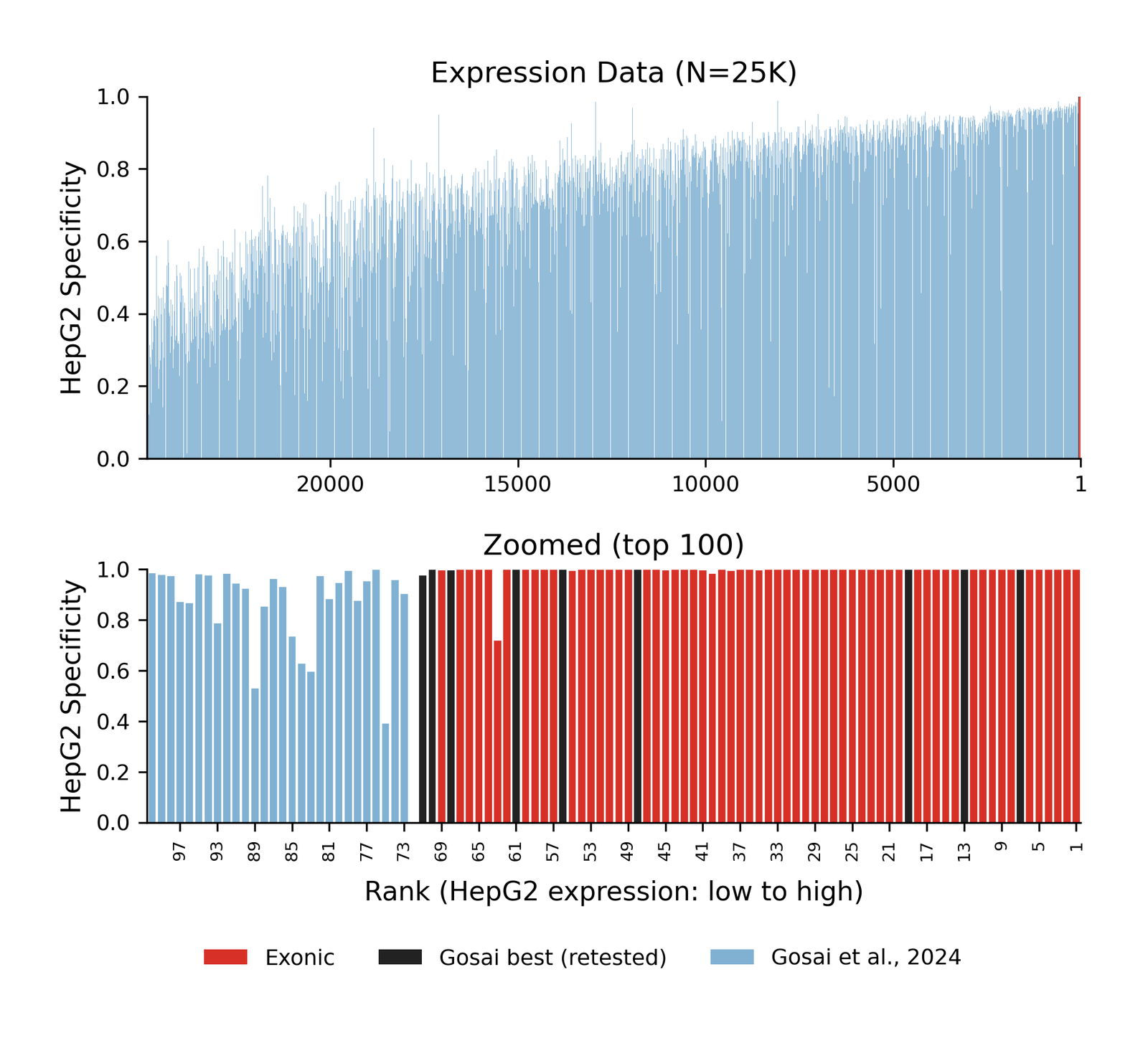
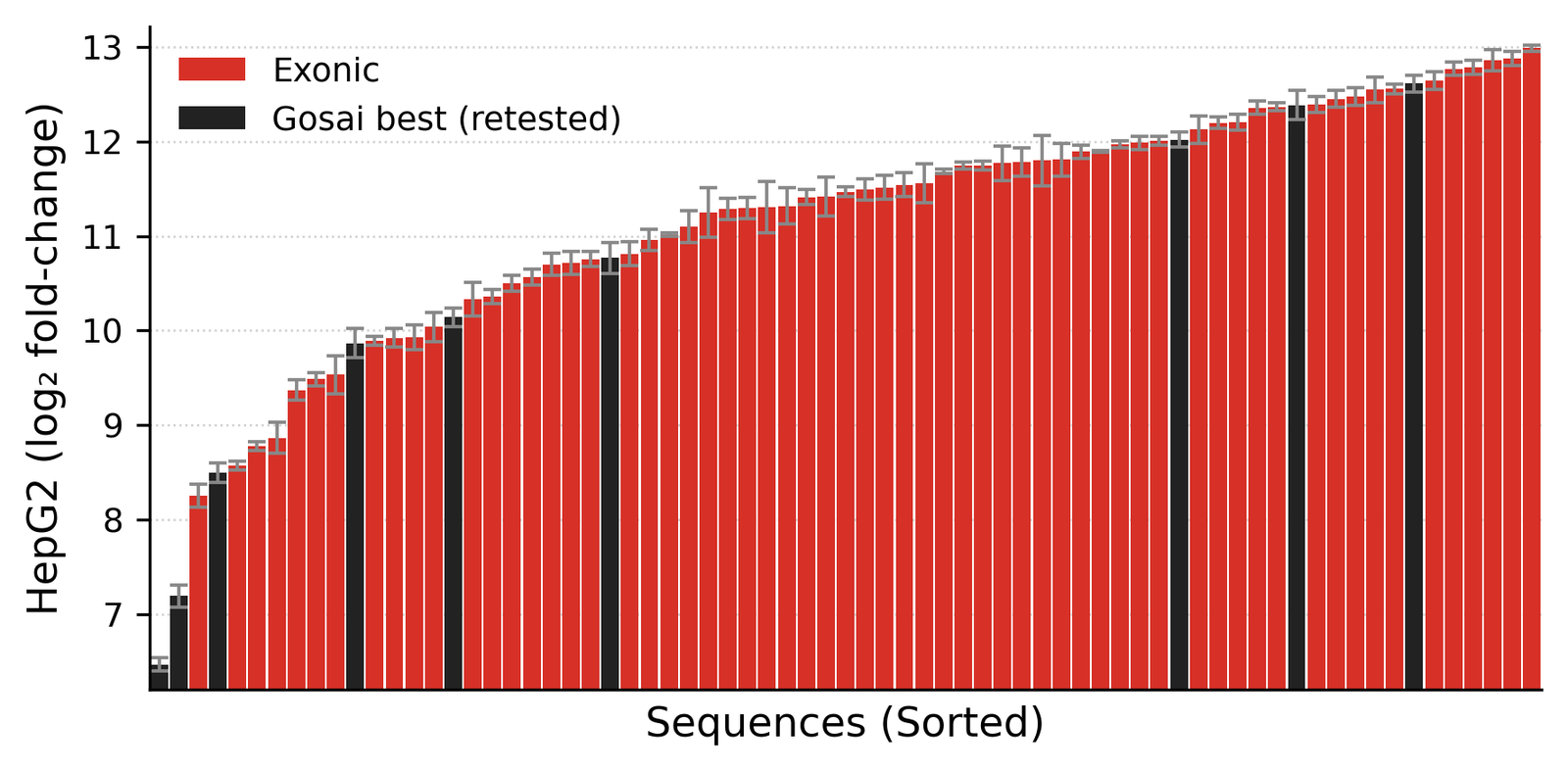
Today Exonic is sharing a research milestone in biological model generalization. Using only data available from Gosai et al., our pipeline consistently outperforms their strongest sequences in HepG2, with effectively zero off-target activation. 6 of our CREs surpass the strongest outlier sequences ever published when compared head-to-head in a dual-luciferase assay, with a maximum improvement of 29.5% fold change. In our experiment, 62 of 63 Exonic-generated CREs outperform the 99.97th percentile sequence (or 8th strongest) from Gosai et al.
Contact
Media & partnerships: press@exonic.ai
Scientific collaborations: science@exonic.ai
Additional information:
Exonic's AI-designed enhancers outperform the strongest published benchmark in the HepG2 cell line. After comparison, our top 6 CREs outperformed the best previously designed CREs in Gosai et al. by up to 29.5% in the HepG2 cell line, while maintaining ≤0.04% relative off-target activation in K562 and SK-N-SH. Here we compute specificity as the fraction of total activity occurring in the target cell type: the target activation divided by the sum of target and off-target activations. Relative off-target activation is then defined as 1 minus the specificity. Further analysis reveals that 62 of 63 (98.4%) generated CREs exceed the prior 8th-best (99.97th percentile out of 24988 total) CRE from the Gosai et al., demonstrating Exonic's ability to produce highly active and cell-type-specific CREs.
Why this matters:
For targeted gene therapies, it is crucial that a drug is only active in the target tissue (cancer, organ, or specific cells) to minimize systemic toxicity. Historically, a level of specificity was achieved by using a carefully designed method of delivery (lipid nanoparticles, viruses, or direct injection of DNA), but it is typically insufficient. One of the latest advancements is cell-type-specific activation of the payload achieved by adding a cis-regulatory element (CRE) to the cassette. Due to relatively weak activity and large size, natural CREs were not an option until the recent advancements in de novo design of cell-type-specific CREs (Gosai et al., 2024).
What has been done:
Machine-guided design of cell-type-targeting cis-regulatory elements (Gosai et al., 2024) trains a deep learning AI model, named Malinois, on the regulatory output of 776,474 200-nucleotide sequences directly, as assayed by MPRA, a high-throughput reporter system that quantifies the effect of a given sequence on gene transcription. In total, they collected functional CRE measurements from 155.3 Mb of unique genomic sequences in each of three human cell types: K562 (erythroid precursors), HepG2 (hepatocytes) and SK-N-SH (neuroblastoma). Malinois demonstrated the ability to design thousands of new de novo CREs with orders of magnitude more activation in target cell lines vs off target cells. Their model falls short as the predicted activation score passes 6 (log2 fold) and higher, with Pearson correlation falling from ~0.9 to ~0.2.
Exonic’s progress:
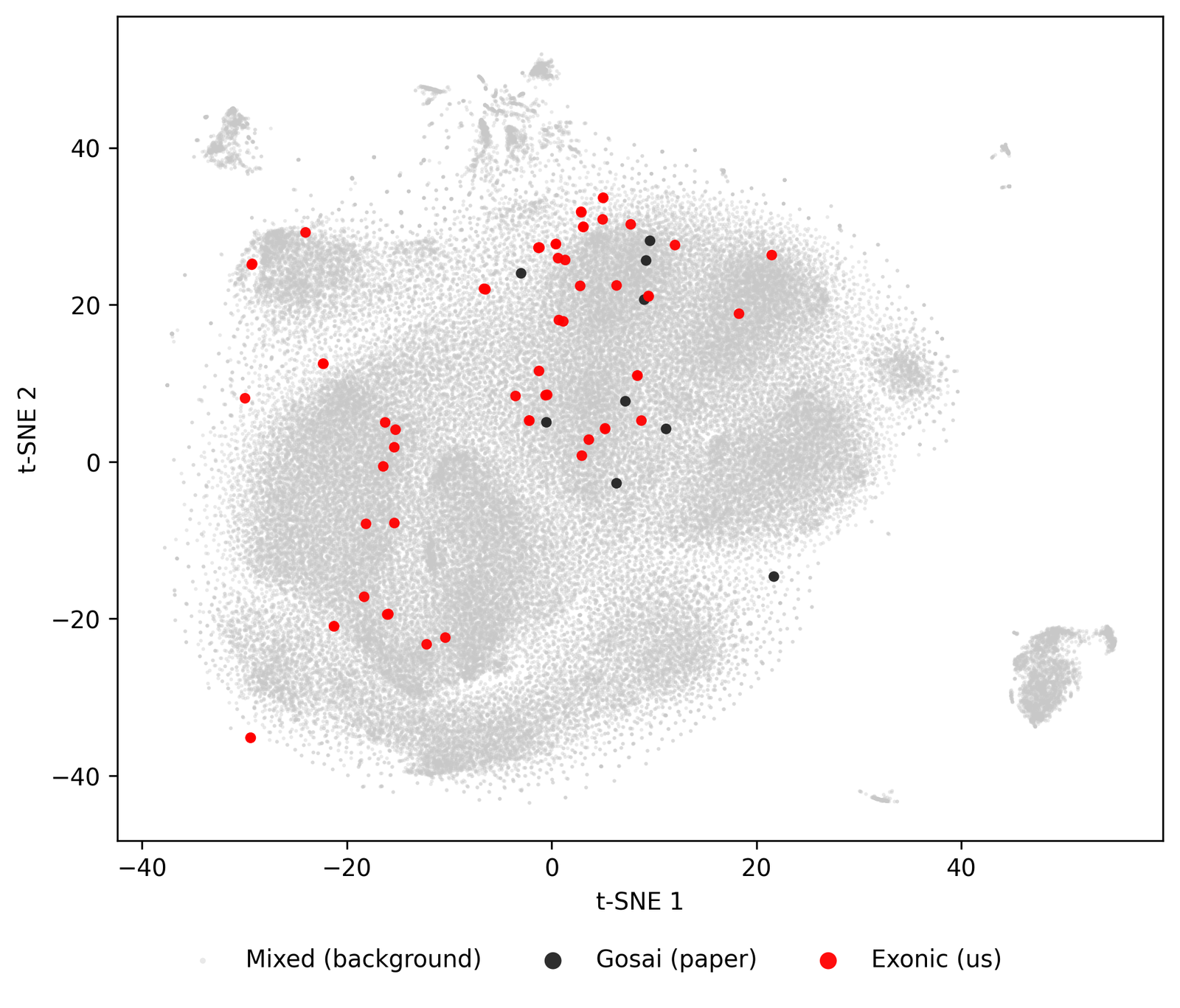
Exonic has built on the groundbreaking work of Gosai et al. by researching the generalization of Malinois and internal, Exonic-trained models at extreme, out-of-distribution activation values. Our AI pipeline has demonstrated the ability to reliably generate CREs with very strong activation in HepG2, surpassing previously published sequences.
Wet lab confirmation:
63 de novo predicted CREs from Exonic’s model pipeline were tested in the wet lab using dual-luciferase assay to validate the activity of the 200bp sequences in vitro. For benchmarking, the 12 strongest reported HepG2 activators in Gosai et al. were used as a comparison and included in the assay pool. Of these 12, 9 were successfully cloned and used as our benchmark anchor.
Benchmarking & Calibration:
We retested the paper’s top 12 HepG2 hits; 9 yielded usable CREs and data. We use these 9 sequences as anchors to align scales and only here make rank claims within that window. Because 62 of 63 Exonic designs sit above the 8th anchor, we report ‘above 8th’ without extrapolating to lower-ranked sequences. When comparing the results of our assay on the anchor sequences to the original reported read-outs, rank agreement is strong: (Spearman 0.85; Kendall’s τ 0.67, top-1 and top-3 rankings preserved).
Discussion:
Natural cis-regulatory elements (CREs) are DNA sequences that control gene expression in particular cell types demonstrating tissue specificity and physiological compatibility due to the nature of origin (Xu and Liu, et al. 2024). Their activity is largely defined by the number and frequency of relevant transcription factor binding site (TFBS) motifs and enhancer activity is correlated with transcription factor expression at the single-cell level (Yin C, et al. 2025). However, natural CREs also have significant limitations, such as restricted strength (max ~100 fold range), inappropriate off-target expression, large size (often 2-4Kb) or complex regulatory context like chromatin or genomic embedding (Lewis MW, et al. 2020, Kim S, at al. 2022). Therefore they may be sub-optimal for therapeutic use. Synthetic CREs are otherwise compact, maintain high strength, cell-type-specificity and minimal off-target effect (Artemyev et al. 2024) but were impractical to develop until recently.
Another advantage of synthetic CREs (enhancers in particular) is, due to their relatively short size, they can be combined and redesigned to target several different types of tissues or targets (dual or even more) with precise accuracy (Taskiran, I.I., et al. 2024). In addition, combining multiple enhancers designed for distinct activity profiles across different target cell types offers a highly novel and desirable strategy (Ray-Jones, H., et al. 2025). Such multi-enhancer architectures can enhance expression strength, refine tissue specificity, and buffer against off-target activation, thereby elevating control over transgene delivery beyond what a single cis-regulatory element can achieve (Kvon et al., 2021; Wu & Huang, 2024; Hong et al., 2025). Their capabilities can even be exploited to target multiple species. In a recently published paper authors were able to create cis-regulatory elements which are active in both bacterial (Escherichia coli) and mammalian (Chinese hamster ovary) cell lines (Wang H., et al. 2025).
Materials and Methods:
Cell lines: HepG2 (HB-8065, ATCC), SK-N-SH (HTB-11, ATCC), and K562 (CCL-243, ATCC) were cultured per supplier recommendations. Only passages less than 6 were used. HepG2 and SK-N-SH were maintained as adherent monolayers in EMEM (ATCC 30-2003) + 10% FBS (Gibco A56705-01) at 37 °C, 5% CO₂. K562 were grown in suspension in IMDM (ATCC 30-2005) + 10% FBS. Cultures were handled aseptically and monitored for viability and morphology.
Reporter constructs: To preserve transferability with the MPRA context of Gosai et al., 200-bp CREs were embedded in an identical nucleotide environment and cloned into pGL4.23 [luc2/minP] (Promega E8411). pGL4.23 was linearized with SpeI (NEB R3133L) and BmtI (NEB R3658L). CREs were synthesized as 488-bp dsDNA fragments (Twist Bioscience, S1 Table 1) and assembled upstream of the minimal promoter using NEBuilder® HiFi DNA Assembly Master Mix (NEB E2621L) (more details in the S2). Two microliters of the assembly were transformed into MultiShot™ StripWell TOP10 competent E. coli (Thermo C409601). Colonies were screened using flanking primers (RVprimer3 CTA GCA AAA TAG GCT GTC CC) and DreamTaq Master Mix (Thermo K1081). Same primers were used to confirm the orientation of the inserts. Renilla control pGL4.74 [hRluc/TK] (Promega E6921) was used unmodified.
Dual-luciferase assay: HepG2, SK-N-SH, and K562 were plated in 96-well plates and, after 24 h at ~70% confluence (~3×10^4 cells/well), co-transfected with 100 ng firefly and 5 ng Renilla (20:1) using Lipofectamine 2000 (1.5 µL/well). At 24h post-transfection, Firefly and Renilla were measured using the Dual-Glo® Luciferase Assay System (Promega E2920) on a GloMax® Discover (GM3000). Firefly was normalized to Renilla per the manufacturer’s protocol. Each construct was measured in ≥3 replicates per cell line; means and SD were calculated.
Reference:
Gosai, S.J., Castro, R.I., Fuentes, N. et al. Machine-guided design of cell-type-targeting cis-regulatory elements. Nature 634, 1211–1220 (2024). https://doi.org/10.1038/s41586-024-08070-z
Lewis MW, Li S, Franco HL. Transcriptional control by enhancers and enhancer RNAs. Transcription. 2019 Aug-Oct;10(4-5):171-186. doi: 10.1080/21541264.2019.1695492. Epub 2019 Dec 2. Erratum in: Transcription. 2020 Feb;11(1):52. doi: 10.1080/21541264.2020.1726602. PMID: 31791217; PMCID: PMC6948965.
Xu, L.; Liu, Y. Identification, Design, and Application of Noncoding Cis-Regulatory Elements. Biomolecules 2024, 14, 945. https://doi.org/10.3390/biom14080945
Artemyev V, Gubaeva A, Paremskaia AI, Dzhioeva AA, Deviatkin A, Feoktistova SG, Mityaeva O, Volchkov PY. Synthetic Promoters in Gene Therapy: Design Approaches, Features and Applications. Cells. 2024 Nov 27;13(23):1963. doi: 10.3390/cells13231963. PMID: 39682712; PMCID: PMC11640742.
Taskiran, I.I., Spanier, K.I., Dickmänken, H. et al. Cell-type-directed design of synthetic enhancers. Nature 626, 212–220 (2024). https://doi.org/10.1038/s41586-023-06936-2
Haochen Wang, Yanhui Xiang, Ziming Liu, Wen Yin, Boyan Li, Long Qian, Xiaowo Wang, Chunbo Lou, De novo design of insulated cis-regulatory elements based on deep learning-predicted fitness landscape, Nucleic Acids Research, Volume 53, Issue 12, 8 July 2025, gkaf611, https://doi.org/10.1093/nar/gkaf611
Kim S, Wysocka J. Deciphering the multi-scale, quantitative cis-regulatory code. Mol Cell. 2023 Feb 2;83(3):373-392. doi: 10.1016/j.molcel.2022.12.032. Epub 2023 Jan 23. PMID: 36693380; PMCID: PMC9898153.
Yin C, Castillo-Hair S, Byeon GW, Bromley P, Meuleman W, Seelig G. Iterative deep learning design of human enhancers exploits condensed sequence grammar to achieve cell-type specificity. Cell Syst. 2025 Jul 16;16(7):101302. doi: 10.1016/j.cels.2025.101302. Epub 2025 Jun 4. PMID: 40472848; PMCID: PMC12221157.
Kvon AZ, Zhu Y, Kelmanson I, et al. Enhancer redundancy in development and disease. Genome Res. 2021;31(1):213–225. PMID:33534806.
Wu C, Huang J. Enhancer selectivity across cell types delineates three functionally distinct enhancer–promoter regulation patterns. BMC Genomics. 2024;25:483. PMID:36928056.
Hong D, Shu M, Liu J, et al. Divergent combinations of enhancers encode spatial gene expression. Nat Commun. 2025;16:5091. PMID:38409577.
Ray-Jones, H., Sung, C.K., Chan, L.T. et al. Genetic coupling of enhancer activity and connectivity in gene expression control. Nat Commun 16, 970 (2025). https://doi.org/10.1038/s41467-025-55900-3
Supplementary Information
S1 200 bp variable part of the 488-bp dsDNA fragments synthesized by Twist Bioscience. For more information see S2 section.
Twist Bioscience uses a silicon-based DNA synthesis method that achieves high accuracy, with a reported industry-leading error rate of approximately 1:7500 bases. Accuracy is ensured through rigorous quality control, including NGS (Next-Generation Sequencing) verification for its Clonal Gene products. Interestingly, initially we synthesized 12 CREs from the Malinois-predicted data set but 3 CREs (highlighted red) failed to be cloned into the pGL4.23 [luc2/minP] due to sequence incompatibilities in Gibson Assembly so only 9 top HepG2 active CREs were used as a comparison and included in the assay pool.
S2 Detailed fragment structure for Gibson assembly. Design and original sequences of fragments used for cloning and luciferase testing. Overall 488-bp fragment structure: 5′ Gibson arm – 200-bp CRE – 3′ Gibson arm.
5′ Gibson arm (226 bp):
TTGAAGCATTTATCAGGGTTACTAGTGTACGGGAGGTATTGGACAGGCCGCAATAAAATATCTTTATTTTCATTACATCTGTGTGTTGGTTTTTTGTGTGAATCGATAGTACTAACATACGCTCTCCATCAAAACAAAACGAAACAAAACAAACTAGCAAAATAGGCTGTCCCCAGTGCAAGTGCAGGTGCCAGAACATTTCTCTGGCCTAACTGGCCGCTTGACG
3′ Gibson arm (62 bp):
CACTGCGGCTCCTGCGATCTAACTGGCCGGTACCTGAGCTCGGCTAGCCTCGAGGATATCAA